
Wine storage isn’t just about stashing bottles in a cool corner, it’s about preserving flavor, structure, and value over time. The wrong setup can turn a prized vintage into expensive vinegar. Wine cellar racks form the backbone of proper storage, keeping bottles horizontal, secure, and accessible while maximizing space. Whether someone’s building a dedicated cellar or converting a closet, choosing the right racking system affects everything from bottle capacity to long-term aging conditions. This guide breaks down rack types, selection criteria, and installation best practices to help DIYers and collectors build storage that actually works.
Key Takeaways
- Wine cellar racks keep bottles horizontal to maintain cork moisture and prevent oxidation, which is essential for preserving flavor and value over time.
- Proper wine cellar racks must account for weight distribution—a full case weighs 40 pounds—and require secure wall-stud anchoring or stable freestanding systems to prevent structural failure.
- Choose between wooden racks (redwood for humidity resistance, mahogany for durability, or pine for budget) or metal systems (lightweight, warp-proof, and modular) based on space, collection mix, and climate control.
- Plan for 20–30% extra capacity to accommodate future growth; a rack that’s 70% full today will overflow within two years.
- Wall-mounted wine cellar racks require level installation using studs and lag screws rated for total weight, while freestanding units need flat, stable bases and anti-tip brackets for safety.
- Position frequently accessed bottles at eye level with labels visible to reduce handling and enable easier inventory management.
Why Wine Cellar Racks Matter for Proper Wine Storage
Wine cellar racks do more than organize bottles, they’re essential to maintaining ideal aging conditions. Storing wine horizontally keeps the cork moist, which prevents air infiltration and oxidation. A dried-out cork can shrink and crack, ruining what’s inside. Quality racks hold bottles at the correct angle without crowding, allowing air circulation around each bottle to maintain consistent temperature and humidity.
Space efficiency matters too. Standard wine bottles measure roughly 11.5–12 inches tall and 2.75–3.5 inches in diameter, but rack systems need to account for champagne magnums, oversized Bordeaux bottles, and irregular shapes. Poorly designed storage wastes vertical space or forces bottles into unstable stacks prone to breakage.
Accessibility is another consideration often overlooked until someone’s trying to pull a specific vintage from the back of a cramped shelf. Good racking systems make inventory management practical, label-forward storage, pull-out drawers, or modular bins all serve different collection styles. For serious collectors tracking hundreds of bottles, ease of access prevents unnecessary handling and disturbance.
Finally, weight distribution is critical. Wine is heavy, a full case weighs around 40 pounds, and larger collections can easily exceed 1,000 pounds. Racks must distribute that load across wall studs or use freestanding systems with adequate footprint and bracing. Structural failure isn’t just inconvenient: it’s expensive and dangerous.
Types of Wine Cellar Racks to Consider
Traditional Wooden Wine Racks
Wooden racks remain the most popular choice for residential wine cellars, combining aesthetics with proven performance. Redwood, mahogany, and pine are common materials. Redwood resists rot and warping in humid environments, making it ideal for temperature-controlled cellars. Mahogany offers durability and a premium look but costs more. Pine is budget-friendly and works fine in climate-controlled spaces, though it’s softer and more prone to dings.
Wooden racks come in several configurations:
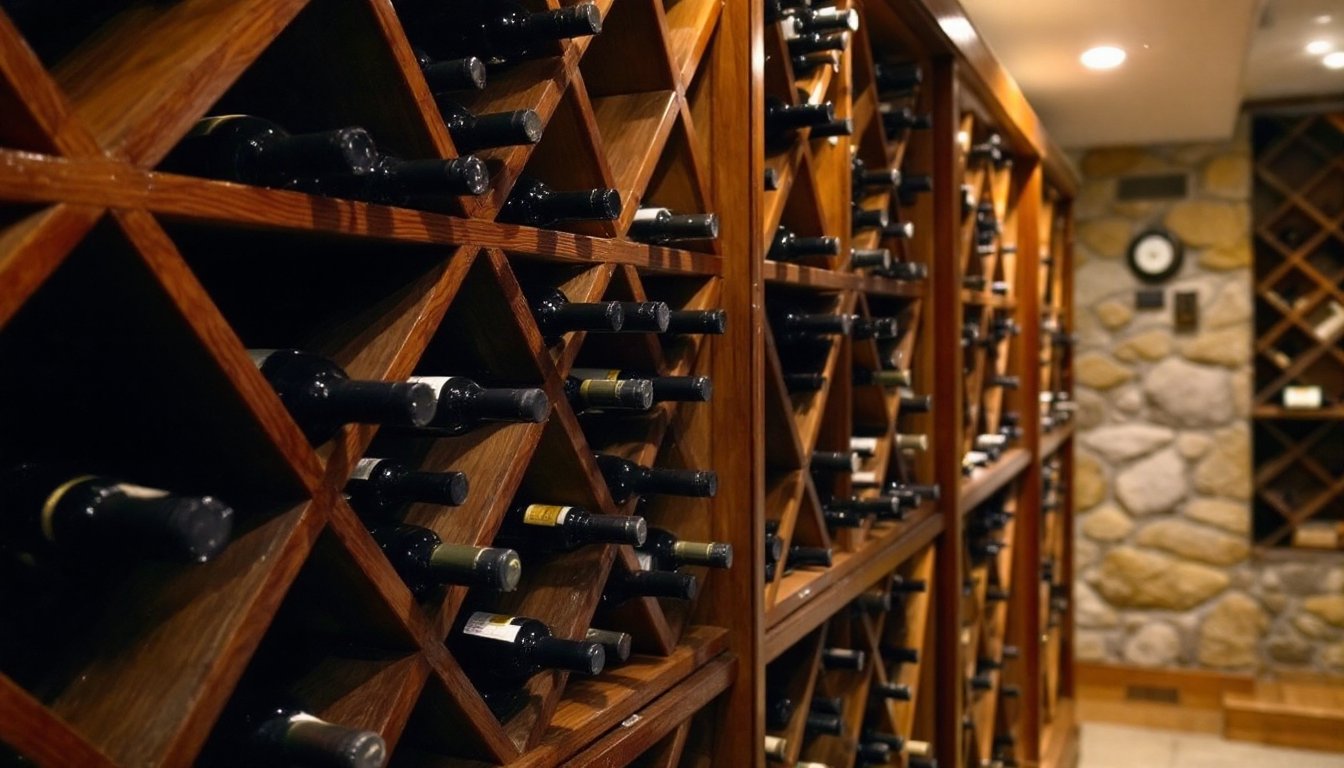
- Individual bottle racks: Each bottle sits in its own cubby, typically in a diamond-bin or rectangular grid pattern. These maximize visibility and access but use more material per bottle.
- Bin-style storage: Bottles stack horizontally in larger compartments holding 12–24 bottles each. Efficient for bulk storage but harder to retrieve specific bottles without disturbing others.
- Display rows: Single-depth rows keep labels visible, perfect for collections where presentation matters.
One trade-off: wood expands and contracts with humidity changes. In a poorly controlled environment, joints can loosen over time. Pre-finished or sealed wood handles moisture swings better than raw lumber.
Metal and Modern Wine Racking Systems
Metal racks, usually powder-coated steel or aluminum, suit contemporary spaces and commercial applications. They’re stronger pound-for-pound than wood, allowing for taller freestanding units or wall-mounted systems with less visible support structure. Metal doesn’t warp, rot, or attract pests, and it’s easier to clean.
Modular metal systems offer flexibility. Many use a peg-and-panel design where pegs slot into pre-drilled wall-mounted panels or freestanding frames. Adjusting capacity means adding or removing pegs rather than rebuilding entire sections. This works well for growing collections or changing storage needs.
Cable wine racks use tensioned steel cables to suspend bottles between floor and ceiling mounts, creating a floating effect. They’re space-efficient and visually striking but require solid attachment points, ceiling joists and floor anchors that can handle tension loads. Not suitable for renters or anyone uncomfortable with structural penetrations.
Metal’s downside? Less insulation value. In cellars where temperature stability is borderline, wood’s thermal mass helps buffer fluctuations. Metal conducts temperature changes faster, though this rarely matters in properly conditioned spaces.
Some hybrid systems combine metal frames with wooden shelves or pegs, splitting the difference on cost and aesthetics.
How to Choose the Right Wine Rack for Your Space
Start with an honest inventory. Count current bottles and estimate future growth. Most collectors underestimate expansion, a rack that’s 70% full today will overflow in two years. Build in 20–30% extra capacity to avoid immediate regret.
Measure the space carefully, accounting for door swing, clearance for pulling bottles, and any HVAC or electrical that can’t be blocked. Standard wine rack depth runs 12–14 inches for single-depth storage, 24–28 inches for double-depth bins. Height depends on ceiling clearance and whether a ladder is acceptable, racks above 7 feet make top rows hard to reach without a step stool.
Bottle mix affects rack choice. A collection heavy on champagne or magnums needs modular systems with adjustable openings or dedicated large-format bins. All-Bordeaux collections fit standard diamond bins efficiently. Mixed collections benefit from flexible peg systems or a combination of rack styles.
Budget matters, but consider cost per bottle stored. A cheap rack that wastes space or fails in three years costs more long-term than a quality system. As of early 2026, expect:
- Pine or basic metal racks: $3–6 per bottle capacity
- Redwood or modular systems: $7–12 per bottle
- Custom mahogany or cable systems: $15–30+ per bottle
Prices vary by region and market conditions, tariffs on imported steel or lumber supply disruptions can shift costs quickly.
Freestanding vs. wall-mounted comes down to permanence and flexibility. Freestanding racks relocate easily and don’t require finding studs, but they consume floor space and can tip if not properly weighted or anchored. Wall-mounted racks maximize capacity in tight spaces but need solid attachment, drywall anchors alone won’t cut it for wine loads. Locate studs (typically 16 inches on center in residential framing) and use lag screws or structural fasteners rated for the total weight.
For conversions in condos or rentals where wall penetration isn’t allowed, freestanding is the only option. Just ensure the base is wide enough for stability, a height-to-base ratio above 3:1 gets tippy.
Finally, think about aesthetics versus function. A showpiece cellar in a finished basement might justify custom woodwork. A utility-room conversion prioritizes cost and capacity. Neither approach is wrong, just match the rack to the room’s purpose and the homeowner’s priorities.
Installation and Maintenance Tips for Wine Cellar Racks
Safety first: Wear eye protection and gloves when cutting or assembling racks. If drilling into concrete (common in basement cellars), use a dust mask rated for silica. Power tools on metal racks require hearing protection.
Before installing, let wooden racks acclimate to the cellar environment for 24–48 hours. This minimizes expansion or contraction after assembly. Skipping acclimation can cause joints to separate or shelves to bow once humidity stabilizes.
For wall-mounted systems:
- Find studs using a stud finder or the knock-and-drill method. Mark centerlines.
- Level the first rail or base piece with a 4-foot level, this is critical. An off-level start compounds across every row.
- Pre-drill holes to prevent splitting wood or cracking drywall. Use a bit slightly smaller than the screw shank.
- Anchor with lag screws (minimum 1/4 inch diameter, 3 inches long) into studs for heavy loads. Toggle bolts work for lighter decorative racks but aren’t suitable for full wine storage.
- Check plumb and level after each section before loading bottles.
Freestanding racks need a flat, stable base. Concrete is ideal. If installing on vinyl or tile, use rubber pads to distribute weight and prevent floor damage. For tall units (over 6 feet), use an anti-tip bracket anchored to the wall, the same kind used for bookshelves and dressers. Wine racks can shift during earthquakes or if someone leans on them while retrieving a bottle.
Maintenance is minimal but important:
- Inspect joints annually for loosening or cracking, especially in wooden racks. Tighten screws or re-glue as needed.
- Wipe down surfaces quarterly to remove dust and prevent mold in humid environments. A damp cloth works: avoid harsh cleaners that can leave residue or odors.
- Check for pest damage in wooden racks, termites or carpenter ants are rare in climate-controlled cellars but not impossible.
- Monitor weight distribution. If adding significantly more bottles, verify that anchors and supports still meet load requirements.
For modular systems, keep a few extra pegs or clips on hand. They’re easy to lose and hard to source individually years later when the product line changes.
If the cellar uses a cooling unit, ensure rack placement doesn’t block air intake or exhaust vents. Restricted airflow forces the unit to work harder and can create hot spots that affect wine quality.
One often-missed detail: label visibility. Position racks so the most frequently accessed bottles sit at eye level (48–60 inches off the floor) with labels facing out. This reduces handling and makes inventory checks faster. Deep bins work for long-term storage of cases bought by the dozen, but daily drinkers deserve easy access.
Conclusion
The right wine cellar rack protects an investment and makes a collection usable, not just stored. Whether it’s redwood bins in a basement or sleek metal pegs in a closet conversion, matching the system to the space, the bottles, and the budget ensures storage that lasts. Measure carefully, anchor properly, and don’t skimp on capacity. A well-planned rack beats expensive regret every time.