
Wine storage isn’t forgiving. A few degrees too warm and bottles age prematurely. Constant temperature swings? Corks expand and contract, letting air spoil the wine. Whether someone’s converting a basement corner or outfitting a custom cellar, getting the temperature right is the single most important factor in preserving quality. This guide breaks down exactly what temperature a wine cellar should be, why it matters, and how to maintain it without guesswork or expensive mistakes. No fluff, just the specs, the reasoning, and the practical steps to dial it in correctly.
Key Takeaways
- The ideal wine cellar temperature is 55°F (12.8°C), with an acceptable range of 45°F to 65°F, but consistency matters more than hitting a perfect number.
- Temperature controls the speed of chemical aging in wine; every 10°F increase roughly doubles the aging rate, so sustained warmth can prematurely flatten flavors and compromise quality.
- Temperature fluctuations cause thermal expansion and contraction that accelerates oxidation through microscopic cork gaps, making steady conditions far superior to seasonal or daily swings.
- Proper wine cellar temperature maintenance requires at least R-19 insulation for walls, R-30 for ceilings, a dedicated wine cooler with humidity control, and regular monitoring with digital thermometers.
- Common mistakes to avoid include using kitchen refrigerators (too cold and unstable), window AC units (lack humidity control), poor door sealing, and proximity to heat sources like furnaces or water heaters.
What Is the Ideal Temperature for a Wine Cellar?
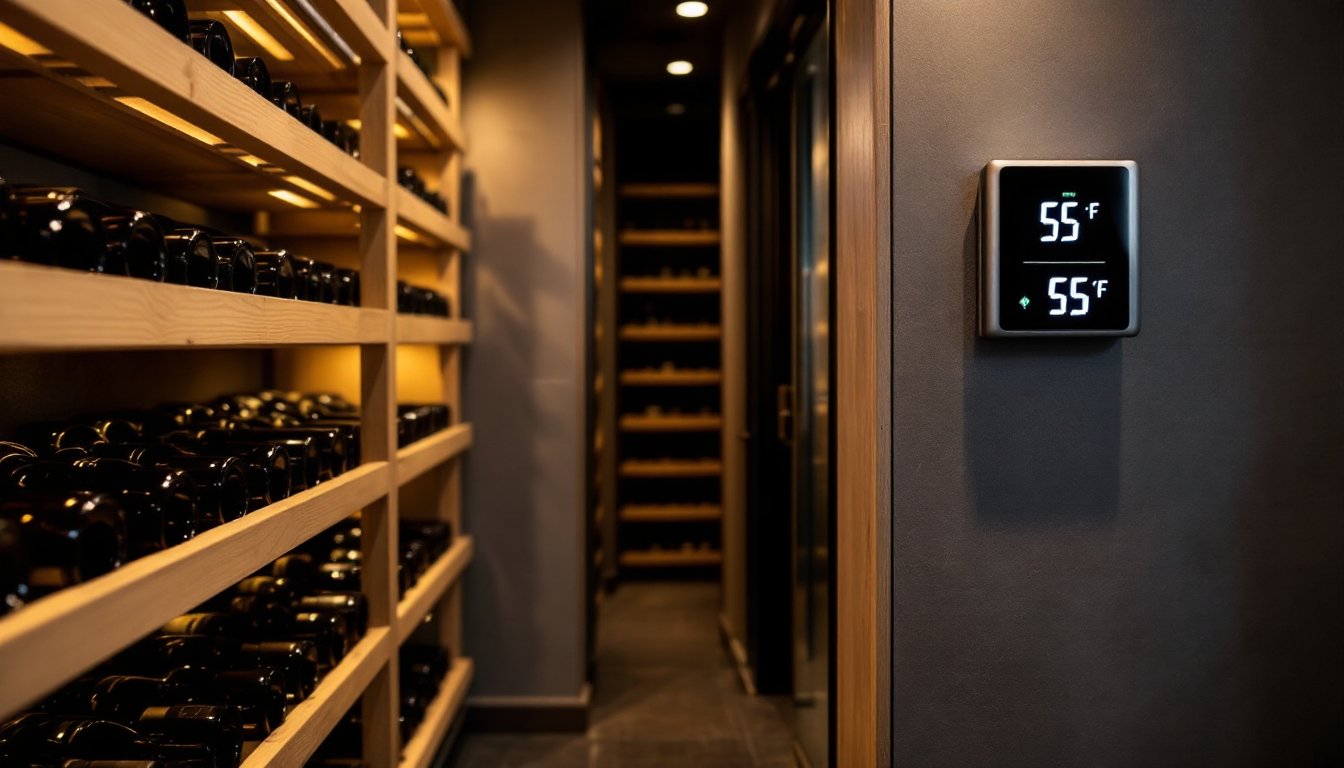
The target is 55°F (12.8°C). That’s the sweet spot for long-term aging of most wines, both red and white. Professional cellars, commercial wine storage facilities, and serious collectors all hover around this number.
The acceptable range runs from 45°F to 65°F, but consistency trumps hitting a perfect number. A cellar that holds steady at 58°F will outperform one that swings between 52°F and 60°F, even though the latter averages closer to ideal.
If someone’s asking what temperature should a wine cellar be for mixed storage, reds, whites, sparkling, 55°F covers all bases. It’s cool enough to slow aging and warm enough to avoid stalling flavor development. Anything below 45°F risks halting the aging process entirely, while sustained temps above 70°F can cook delicate compounds and ruin balance.
Why Temperature Matters for Wine Storage
Temperature controls the speed of chemical reactions inside the bottle. Wine isn’t static, it’s evolving. Tannins soften, acids mellow, aromatics develop complexity. All of that happens through slow oxidation and interaction between compounds. Heat accelerates those reactions: cold slows them down.
Too warm, and wine ages faster than intended. A bottle meant to peak in ten years might be over the hill in five. Flavors flatten, fruit characters fade, and oxidation takes over, leaving a dull, cooked taste. Heat also expands the liquid, pushing against the cork and potentially breaking the seal.
Too cold isn’t as immediately destructive, but it stalls development. Wines stored below 45°F age so slowly they may never reach their potential. Extreme cold can even push corks out or cause tartrate crystals (harmless but unsightly) to form.
How Temperature Affects Wine Aging
Every 10°F increase roughly doubles the rate of chemical aging. A wine stored at 75°F will age about twice as fast as one kept at 65°F, and four times as fast as one at 55°F. That’s not a linear relationship, it’s exponential.
For short-term storage (a few months), minor temperature variation is manageable. But for cellaring wine over years or decades, even a 5°F sustained difference changes the outcome. Collectors targeting a specific aging window need precision, not approximation.
Temperature also affects cork integrity. Natural corks expand and contract with heat. Repeated cycles dry them out, creating gaps that let oxygen seep in. Synthetic corks and screw caps handle temperature swings better, but most fine wines still use natural cork, so temperature stability protects the closure as much as the wine.
Temperature Fluctuations and Wine Quality
Steady beats perfect. A cellar that holds 58°F year-round will preserve wine better than one bouncing between 50°F in winter and 65°F in summer.
Fluctuations cause thermal expansion and contraction. Wine expands when warm, pressing outward on the cork. When it cools, it contracts, creating negative pressure that can pull air back through microscopic gaps. Over time, this pumping effect accelerates oxidation and spoilage.
Daily swings aren’t as harmful as seasonal ones, but both should be minimized. A variation of ±3°F over 24 hours is acceptable in most home cellars. Seasonal drift of more than 5°F total indicates inadequate insulation or climate control.
Basements typically offer natural stability, earth acts as thermal mass, buffering outdoor temperature changes. But uninsulated basements near furnaces, water heaters, or exterior walls can still swing 10°F to 15°F across seasons. That’s enough to compromise long-term storage.
If someone’s cellar swings more than 5°F throughout the year, the fix is usually better insulation (spray foam or rigid foam board on walls and ceiling) or a dedicated wine cellar cooling unit. These aren’t standard HVAC units, they’re designed to hold tight temperature ranges and manage humidity simultaneously.
Different Temperature Zones for Different Wines
If someone’s building a cellar exclusively for reds or whites, they can fine-tune the target:
- Red wines: 55°F to 60°F for aging: 60°F to 65°F for short-term storage before serving.
- White wines and rosé: 45°F to 50°F for long-term storage: closer to 50°F to 55°F for everyday drinking inventory.
- Sparkling wines and Champagne: 45°F to 50°F. Lower temps preserve carbonation and slow oxidation of delicate bubbles.
For a dual-zone cellar, a cooling system with separate controls can maintain 55°F in the main chamber and 48°F in a smaller section for whites and sparkling. This requires a partitioned space and either two cooling units or one multi-zone model.
Most home cellars don’t need zones. Storing everything at 55°F works fine. Whites pulled from a 55°F cellar can be chilled in a refrigerator for 30 minutes before serving. Reds can be brought up to room temp gradually. The storage temp is about preservation, not serving temp.
Serving temperature is a separate consideration: reds are typically served at 60°F to 68°F, whites at 45°F to 55°F, and sparkling at 40°F to 50°F. A cellar at 55°F puts everything in the ballpark without overthinking it.
How to Maintain Consistent Wine Cellar Temperature
Consistency requires insulation, climate control, and monitoring.
Insulation is the foundation. Walls, ceiling, and door should hit at least R-19 (for walls) and R-30 (for ceiling). Closed-cell spray foam is ideal, it insulates and air-seals in one pass. Rigid foam board (like XPS or polyiso) works too, especially over concrete. Don’t skip the vapor barrier: moisture infiltration will wreck both insulation and wine labels.
A proper wine cellar door should be insulated and weatherstripped. Standard hollow-core doors leak too much air. Exterior-grade or custom wine cellar doors with gaskets and thresholds are worth the investment.
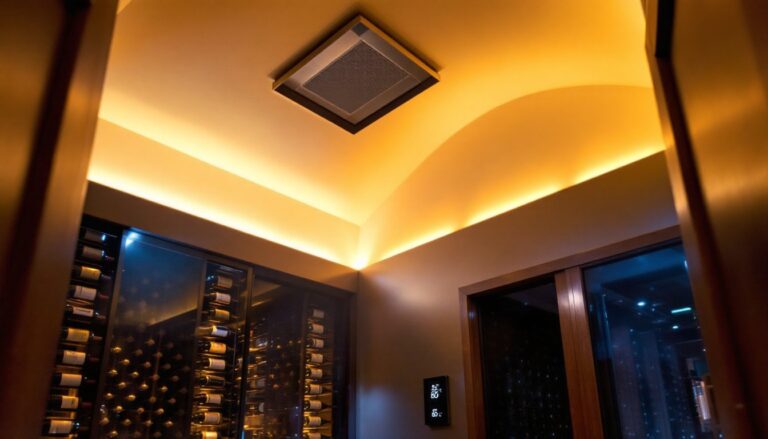
Cooling units designed for wine cellars maintain both temperature and humidity (ideally 50% to 70% RH). These aren’t window AC units, wine cellar coolers are engineered for narrow setpoint ranges and continuous operation. Through-the-wall units (like WhisperKOOL or CellarPro) are common for spaces under 1,000 cubic feet. Ducted systems work for larger or irregularly shaped cellars.
Size the unit correctly: calculate cellar volume (length × width × height), then add 20% to 30% if there’s glass, poor insulation, or exterior walls. Undersized units run constantly and fail early. Oversized units short-cycle, causing temp swings.
Monitoring prevents silent failures. Use a digital thermometer/hygrometer with min/max memory or a Wi-Fi-connected monitor that alerts if temps drift. Check it weekly, especially in the first year.
Passive options exist for small collections or moderate climates: insulated basement corners or closets with good earth contact can hold 55°F to 60°F naturally if the home’s HVAC keeps ambient temps reasonable. But anything beyond a few dozen bottles or more than a few years of aging justifies active cooling.
Common Wine Cellar Temperature Mistakes to Avoid
Using a standard refrigerator for long-term storage. Kitchen fridges run 35°F to 40°F, too cold for aging, and their compressors cycle aggressively, causing vibration and humidity swings. They’re fine for a few weeks, not years.
Relying on a window AC or portable AC unit. These lack humidity control, can’t hold tight temp ranges, and often freeze up or quit in cooler months. They’re also loud and inefficient for small, insulated spaces.
Skipping insulation to save money upfront. An uninsulated cellar forces the cooling unit to run nonstop, spiking energy bills and shortening equipment life. Insulation pays for itself in lower operating costs and better wine preservation.
Ignoring the door. Air leaks around a poorly sealed door negate even the best cooling system. Weatherstripping, a door sweep, and a solid-core or exterior-grade door are non-negotiable.
Placing the cellar near heat sources. Furnaces, water heaters, dryers, and sun-facing exterior walls all dump heat into adjacent spaces. If the only option is near a heat source, add extra insulation and a larger cooling unit.
Not checking humidity. Low humidity (below 50%) dries out corks, leading to oxidation. High humidity (above 80%) promotes mold on labels and wood. Wine cellar cooling units typically manage this, but passive cellars need separate monitoring and possibly a humidifier or dehumidifier.
Setting and forgetting. Even the best system can fail, a compressor dies, a drain clogs, a power outage goes unnoticed. Regular checks and remote monitoring catch problems before bottles are ruined.